YELLOW FINCH
Gas Monitoring Network
Optically powered gas monitoring for underground coal mines. Real-time detection of CH4, CO2, CO and O2 with intrinsically safe sensors connected via optical fibre cable.

We acknowledge support by the Australian Coal Industry's Research Program, ACARP.
Technology
Product Overview
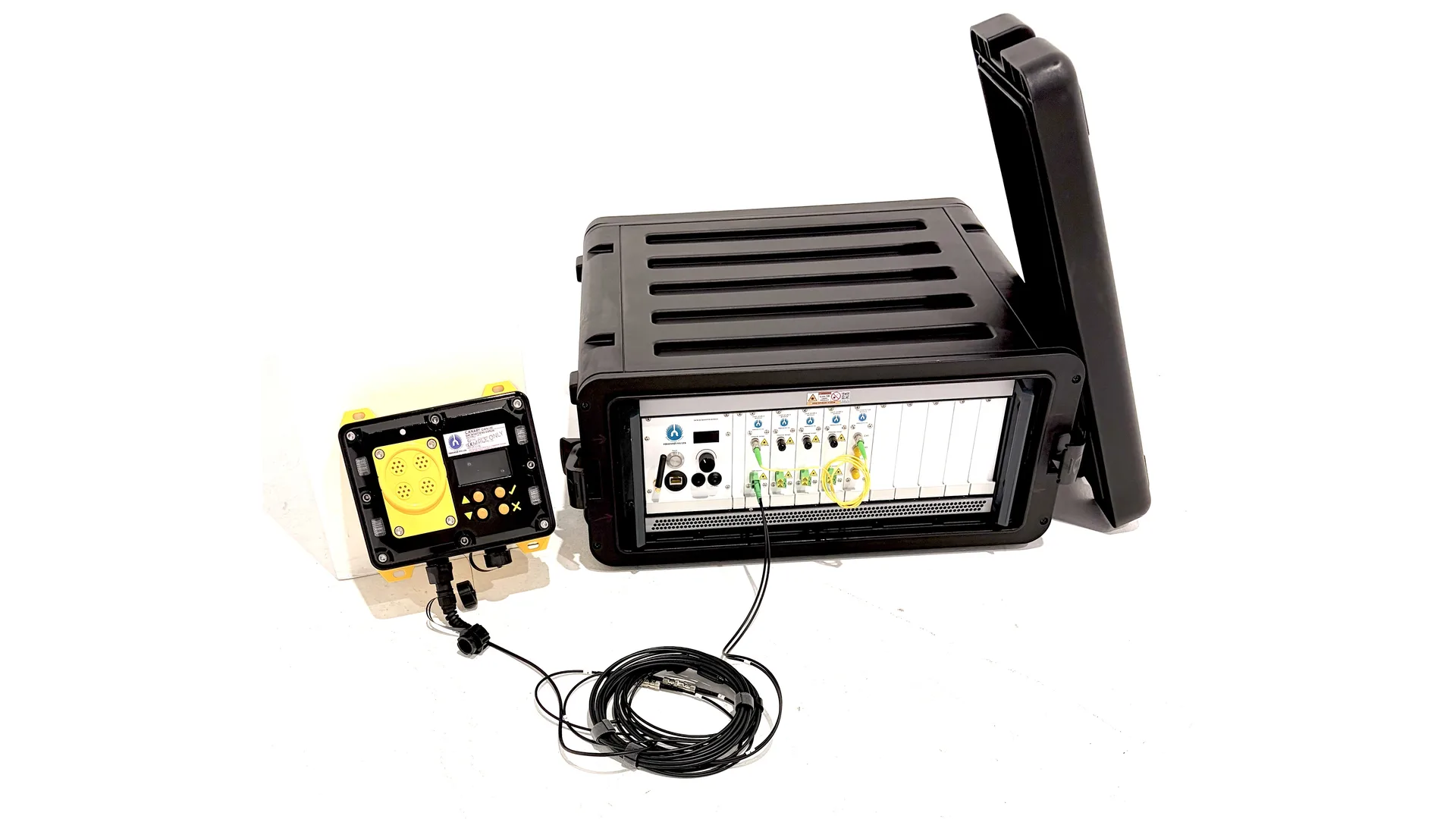
The Yellow Finch GMN is an optically powered gas monitoring network designed for real-time monitoring of CH4, CO2, CO and O2 in underground coal mines. It consists of four intrinsically safe, optically powered Gas Monitoring Stations (GMS) connected to a Remote Terminal Unit (RTU) via a ruggedised optical fibre cable. The RTU can be located kilometres away on the surface or in a non-hazardous area, where electrical power is available. The GMS units are optically powered and intrinsically safe (Ex ia).
Optically Powered
No electrical power in the hazardous zone. The GMS is powered entirely by light transmitted through the optical fibre, making it intrinsically safe (Ex ia) for use in explosive atmospheres.
Multi-Gas Detection
Simultaneous real-time monitoring of four critical gases: methane (CH4), carbon dioxide (CO2), carbon monoxide (CO), and oxygen (O2), plus temperature and air pressure.
Dedicated Fibre Links
Each GMS connects to the RTU via a dedicated ruggedised multi-core optical fibre cable. The RTU supports up to 8 GMS units with modular Light Source and Photodetector Modules.
Applications
Where Yellow Finch Operates
Underground Coal Mining
Continuous gas monitoring in underground coal mines, where methane and other hazardous gases pose constant risks to worker safety and operations.
- —Methane detection
- —Ventilation monitoring
- —Safety compliance
Tunnelling
Gas monitoring in tunnel construction environments where excavation may encounter pockets of hazardous gases requiring real-time detection and alerting.
- —Tunnel boring
- —Confined spaces
- —Construction safety
Industrial Environments
Gas monitoring in any environment where explosive or toxic atmospheres may be present and where intrinsically safe equipment is mandated.
- —Chemical plants
- —Oil and gas facilities
- —Hazardous zones
Underground
Gas Monitoring Station
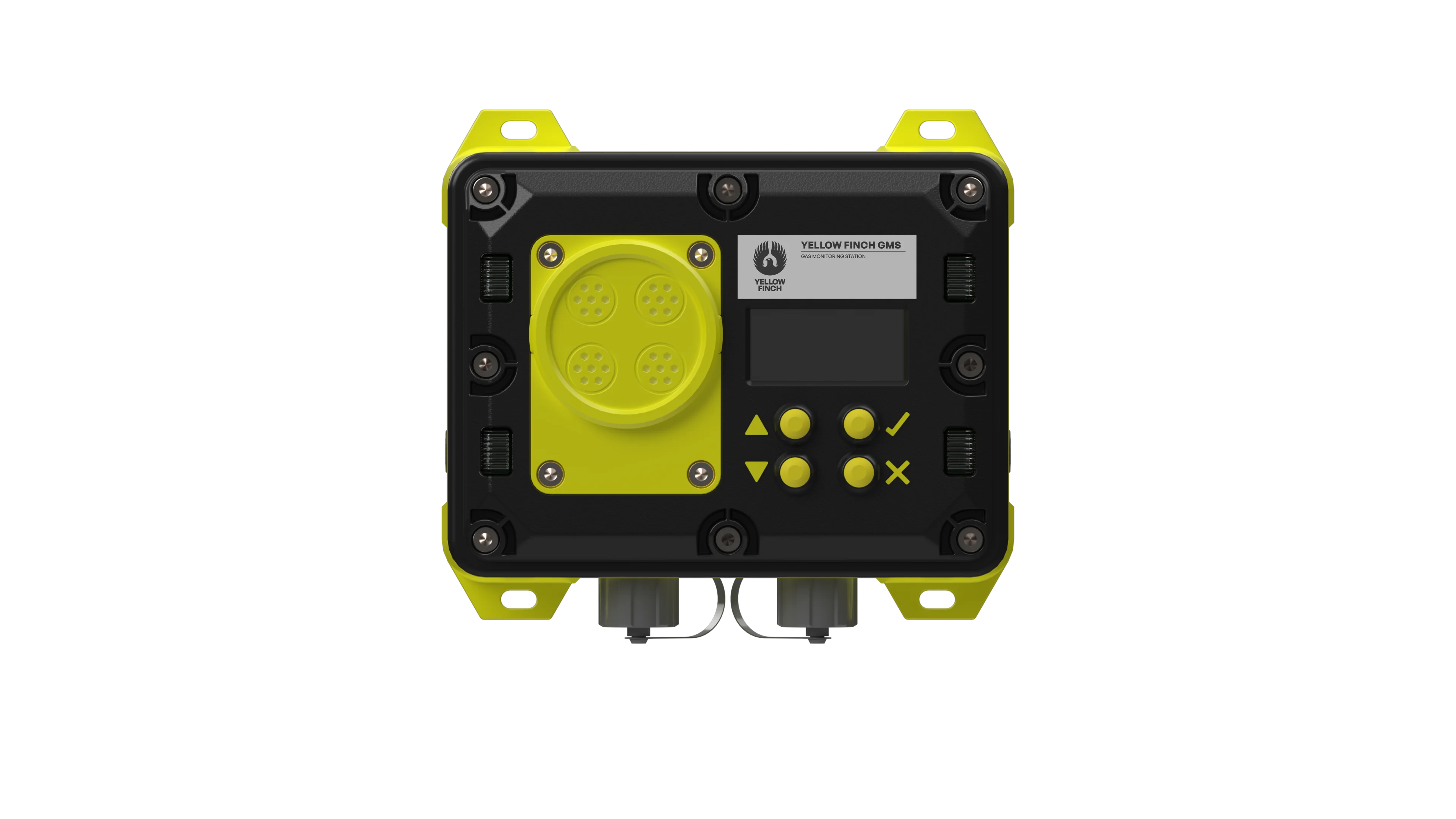
The GMS is an intrinsically safe, optically powered Gas Monitoring Station with one battery as auxiliary power. The local display shows real-time readings of gas concentrations of CH4, CO2, CO and O2, and together with the keypad, users can configure its settings. With industry standard optical cable bulkheads at the bottom, GMS is powered by the light from the Light-in port.
GMS Components
- Gas Sensors
- 4x digital (CH4, CO2, CO, O2)
- Environmental
- Temperature + Air Pressure
- Display
- LCD
- Interface
- Keypad + Bluetooth
- Alarm
- LED Strobe (visible)
- Power
- <148 mW optical + IS Battery
- Output Signal
- Digital (SFK), Wireless, Bluetooth
- Connection
- Optical Cable Bulkheads
- Sampling Rate
- 1 Hz (adjustable)
- Resolution
- 12-bit
- Max Fibre Length
- 10 km
- Weight
- <1 kg
- Dimensions
- 225 × 200 × 72 mm
- Ingress Protection
- IP 54
- Operating Temp
- 0 to 40°C
- Pressure Range
- 300 to 1100 hPa
- Warmup Time
- 60 s
- Calibration
- In-situ
- Safety Rating
- Ex ia op is I Ma
- Certification
- IECEx ExTC 26.0005X
RTU Specifications
- Core Module
- Data Acquisition Module (DAM)
- Light Sources
- 8x LSM Slots
- Photodetectors
- 2x PDM (4 channels each)
- Max GMS Units
- 8
- Connectivity
- Wi-Fi + Ethernet
- Display
- LCD
- Data
- Real-time webpage + Logging
- Power Supply
- 240V AC at 50 Hz
- Form Factor
- 19" Rackmount 4U
- Weight
- <10 kg
- Certification
- IECEx ExTC 26.0006X [Ex ia op is Ma] I
Surface
Remote Terminal Unit

The RTU consists of a chassis which houses a Data Acquisition Module (DAM) capable of hosting eight Light Source Modules (LSMs) supporting eight GMS units and two corresponding Photodetector Modules (PDMs). Located on the surface or in a non-hazardous area, it converts optical signals from the GMS units into digital data accessible via Ethernet and Wi-Fi.
Research
White Papers
Liquid Crystal Based Optical Telemetry Applied to 4–20 mA Current Loop Networks
Research paper on liquid crystal based optical telemetry applied to current loop networks, underlying the Yellow Finch system.
PDFDownload →Optical Response of Homeotropically Aligned Ferroelectric Liquid Crystal
Technical paper on fibre optic measurement principles and applications in sensing environments.
PDFDownload →Optically Interrogated Liquid Crystal-Based, Charge-Mode Accelerometer Telemetry
Research on optically interrogated accelerometer telemetry using liquid crystal transduction.
PDFDownload →Recognition
Funding & Awards
22 September 2025
ACARP Funding ($810,332)
PhoenixZ has secured funding from the Australian Coal Association Research Program (ACARP). This funding recognises the industry's interest in next-generation intrinsically safe gas monitoring technology and will support the continued development and field evaluation of the Yellow Finch system in collaboration with the Australian coal industry.

15 April 2026
Industry Growth Program (IGP) Funding ($649,105)
PhoenixZ has been awarded funding under the Australian Government's Industry Growth Program (IGP) through the Commercialisation and Growth stream. This funding recognises the commercial potential of PhoenixZ's technology and will accelerate the further development, refinement and commercialisation of the Yellow Finch fibre-optic gas monitoring system. It will also support the advancement of PhoenixZ's broader portfolio of advanced fibre-optic sensing technologies for the mining and defence industries, strengthening the company's capability to develop and commercialise innovative Australian technologies for both domestic and international markets. The funding will enable PhoenixZ to further enhance the performance, reliability and manufacturability of its products while accelerating their deployment into the mining industry and supporting the company's long-term growth strategy.
Our People
The Team

Dr. Zourab Brodzeli
CEO
The founder and CEO of PhoenixZ Pty Ltd, leading the commercialization of advanced photonics and fiber-optic sensing technologies for mining safety, subsea monitoring, and industrial applications. A physicist by training, Dr. Brodzeli has extensive experience in research, engineering, and technology transfer, with a strong focus on turning innovative science into practical, real-world solutions. He drives PhoenixZ's strategic vision, product development, and industry partnerships, working closely with clients and collaborators to deliver robust, intrinsically safe sensing systems that enhance safety, security, and operational performance across critical infrastructure sectors.
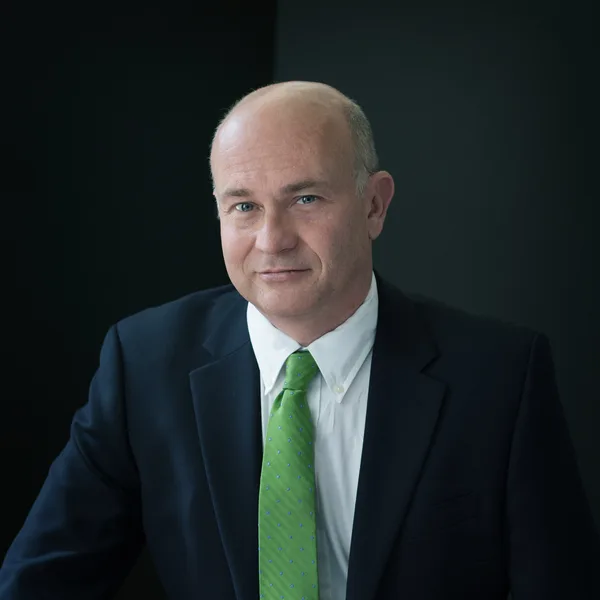
Dr Adrian Carter
Director & Strategic Technology Advisor
Dr Adrian Carter is an internationally recognised expert in specialty optical fibre technology and the former founder and Chief Technology Officer of Coherent-Nufern. Over a career spanning research, technology development and commercialisation, he has made pioneering contributions to the design, fabrication and application of specialty optical fibres, including fibres for high-power laser and amplifier systems. He has published extensively and holds numerous U.S. patents covering various aspects of optical fibre technology.
Adrian is a Fellow of SPIE, Optica and the Australian Institute of Physics (AIP), reflecting his internationally recognised contribution to photonics and optical-fibre technology. At PhoenixZ, he brings a rare combination of deep technical expertise, experience in taking advanced photonics technologies from research through to commercial products, and first-hand experience in building and growing a technology company. His expertise provides PhoenixZ with strategic guidance across optical and fibre technologies, product development and commercialisation.

Fernan Bautista
Mechanical Engineering and Production
Drives the mechanical development of our devices with a focus on precision and reliable design. Enjoys tackling the unique challenges of hardware built for extreme environments, turning complex technical needs into operational systems that perform across a variety of fields.

George Triantafillou
Electronics Engineer
George Triantafillou is an Electronics Engineer specialising in electronic hardware design, PCB development, embedded systems and firmware engineering. He graduated with Honours in Electrical Engineering from the University of Technology Sydney and has successfully developed multiple electronic products that have progressed into commercial production. His experience spans the agriculture, medical and mining sectors, providing him with a strong background in designing reliable, high-performance electronic systems for demanding industrial applications.
George has expertise in analogue and digital electronics, mixed-signal circuit design, PCB layout, embedded firmware development, hardware integration and system testing. He also has expertise in the design of Intrinsically Safe (IS) electronic hardware in accordance with the requirements of IEC 60079-0 and IEC 60079-11, enabling the development of equipment for hazardous industrial environments. His combination of technical expertise, practical engineering experience and commitment to innovation contributes to the development of advanced sensing and monitoring technologies for mining, defence and other industrial applications.

David Elishua
Consultant, Electrical Engineering (IS)
Brings our hardware to life by managing the electronic architecture and embedded systems. Dedicated to creating the smart logic and circuit designs that keep our systems connected and functioning perfectly, even in the most challenging settings.
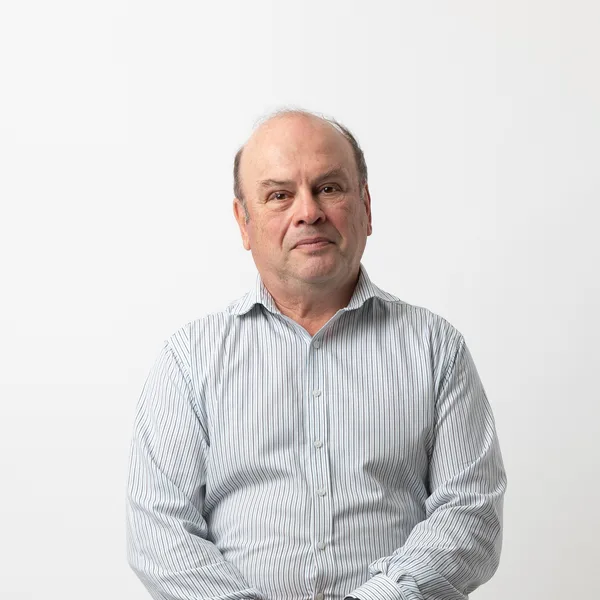
Michael Raikhman
Consultant, Electronics Engineering
Michael Raikhman is a highly skilled Electronics Engineering Consultant, specialising in system and component level electronics hardware design and development for R&D and manufacturing applications.
Michael is an expert in RF/Microwave, fibre optical and mixed signals schematics design and PCB layout, developing products for Telecommunications, Radio Communications, IoT, industrial and medical applications. He graduated from the Moscow Technical University of Telecommunications and Informatics with an Honours Degree in Broadcasting and Radio Communication Engineering.
Get in Touch
Contact Us
Contact us for specifications, pricing, and partnership opportunities.
Message Sent
Thank you for reaching out. We'll get back to you shortly.